Savannah, Tybee Island, Charleston… și șeriful
După primele săptămâni în Athens, începusem deja să înțelegem un lucru despre America: distanțele sunt relative. Câteva ore cu mașina nu mai par chiar atât de multe atunci când la capătul drumului te așteaptă un oraș nou și, mai ales, oceanul. Așa că am plecat dimineața din Athens spre Savannah. Și, pentru că afară erau în jur de 41°C, am decis destul de repede că ideea de a descoperi orașul exclusiv pe jos era mai degrabă un test de rezistență decât turism.
Am ales una dintre imaginile clasice ale orașului: trolley-ul turistic, cu bănci de lemn, ferestre deschise și un șofer-ghid care ne-a plimbat prin Savannah povestindu-ne despre locurile pe lângă care treceam. S-a dovedit o alegere excelentă. Șoferul nostru avea un simț al umorului grozav și, printre povești despre clădiri, personaje și istoria orașului, strecura glume care făceau turul să semene mai degrabă cu o plimbare alături de cineva care știe toate poveștile bune.


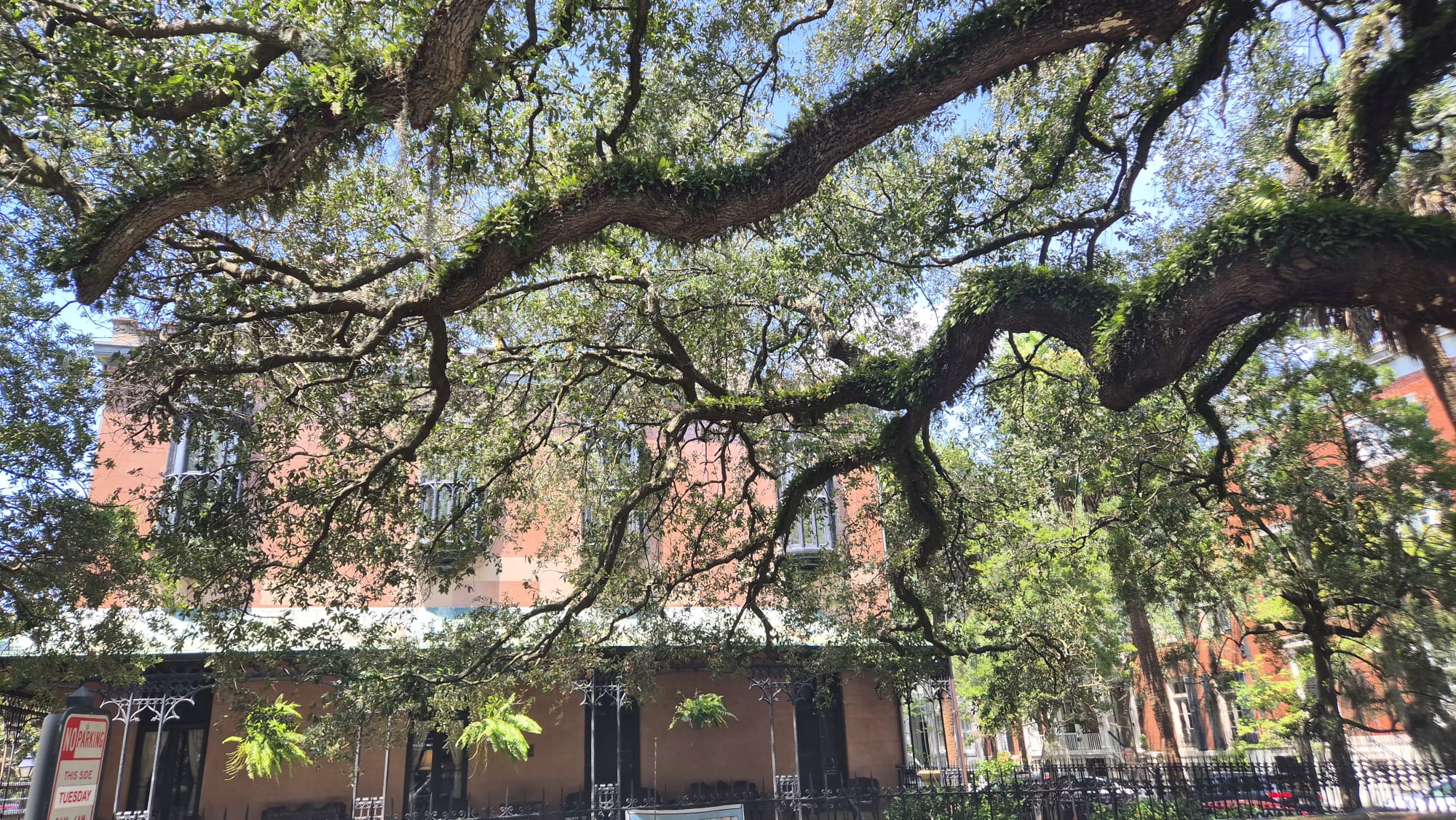
Savannah chiar pare făcut pentru a fi descoperit încet: case vechi cu verande, biserici, străzi pavate și piețe umbrite. Dar ceea ce ne-a rămas cel mai mult în minte au fost stejarii uriași, cu Spanish moss atârnând din ramuri. Și, surpriză, nu este de fapt mușchi, ci o plantă aeriană, din genul Tillandsia. O vezi peste tot prin Savannah și contribuie mult la aspectul atât de specific al orașului.


Și, pentru că nu poți merge până la Savannah doar pentru arhitectură și istorie, a venit și partea serioasă a excursiei: mâncarea. Dacă tot ajunseserăm pe coasta Georgiei, trebuia să încercăm ceva specific locului. Alegerea a fost shrimp and grits – creveți serviți cu grits, un preparat din porumb foarte popular în bucătăria Sudului Statelor Unite. Pentru noi, combinația nu era tocmai una la care ne-am fi gândit acasă, ceea ce era încă un motiv să o încercăm.
Și apoi a venit desertul. Am ajuns la Leopold’s Ice Cream, una dintre gelateriile celebre din Savannah. Nu avem dovada fotografică – ceea ce, privind retrospectiv, este aproape suspect – dar putem confirma că porția a fost uriașă. Atât de mare încât probabil fotografia ar fi avut nevoie de modul panoramic.


Tybee Island: Atlanticul, dar nu chiar cum ni-l imaginam
După Savannah, am pornit spre Tybee Island. De la străzi, clădiri istorice și trolley am ajuns, în sfârșit, la Oceanul Atlantic.
Ne imaginaserăm apa rece, poate chiar suficient de rece încât să ne trezească după o zi întreagă petrecută la peste 40°C.
Surpriză.
Am intrat în apă și prima reacție a fost aproape unanimă: o ciorbă.
Oceanul era incredibil de cald. După căldura de peste zi nu ne-a răcorit prea tare, dar prima noastră baie în Atlantic, seara, cu soarele coborând spre orizont, a compensat din plin.
La intrarea pe plajă ne aștepta și un panou generos, care ne explica tot ce NU aveam voie să facem: fără animale, fără sticlă, fără artificii, fără gunoi și, foarte important, NO SMOKING OR VAPING. Ultimul punct a fost primit cu mult mai puțin entuziasm de Veronica decât restul regulamentului. Atlanticul era superb. Apusul era superb. Tybee Island era superbă. Faptul că nici măcar nu puteai vapa pe plajă? Mult mai puțin superb.
Dar Tybee avea și lucruri care ne-au atras atenția. Pe lângă avertismentele despre rip currents, am găsit indicatorul care arată până unde poate ajunge valul asociat diferitelor categorii de uragane.


Pentru noapte am rămas pe insulă, într-un motel cu camerele deschise direct spre exterior, balustradă în fața lor și mașina parcată aproape de ușă. Experiența venea însă și cu un bonus autentic de coastă: umiditatea. Era atât de mare încât costumele de baie puse la uscat seara erau dimineața aproape exact cum le lăsaserăm.


A doua zi: micul dejun din Seinfeld

Dimineața am mers la Sunrise Breakfast, iar când am intrat, primul gând a fost: Seinfeld.
Mesele, banchetele, cănile de cafea, oamenii care își luau liniștiți micul dejun – totul arăta ca dineurile americane pe care le știam din filme și seriale. Și apoi a apărut doamna cu cafeaua la filtru.
Cafeaua aici pare să funcționeze după o regulă simplă: ceașca nu trebuie lăsată niciodată să ajungă goală. Abia beam câteva guri și doamna apărea din nou: More coffee? Pentru niște europeni obișnuiți cu espresso, ritualul cafelei americane, lungi și reumplute la nesfârșit, era o experiență în sine.
Apoi a venit micul dejun. Ouă, bacon, cartofi, pâine prăjită și, bineînțeles, pancakes americane – groase, pufoase și suficient de mari încât să te întrebi dacă sunt garnitură, desert sau un mic dejun separat.

Cu ceștile de cafea reumplute pentru a nu știm câta oară și cu farfuriile pe care nu aveam nicio șansă să le terminăm, bifaserăm și the real American breakfast.
Iar după asta puteam pleca liniștite spre Charleston. Sau, mai corect spus, rostogolite spre Charleston.
Charleston: frumos. Foarte frumos. Și infernal de cald.

Drumul a început spectaculos, cu podurile uriașe care par să confirme încă o dată că în America, dacă se poate construi ceva mare, atunci se construiește foarte mare.
Charleston ne-a întâmpinat exact cum îl văzuserăm în fotografii: case elegante, obloane, străduțe înguste, flori, palmieri și clădiri în culori pastelate. Un oraș superb, în care ai putea să te plimbi ore întregi.


Și pentru că eram în South Carolina, trebuia să încercăm ceva specific locului. Așa am ajuns la she-crab soup, celebra supă cremoasă de crab asociată cu Charleston. O supă densă și caldă, după ce umblasem prin oraș la peste 40°C. Probabil nu cea mai inspirată combinație climatică. Dar eram în Charleston. Trebuia încercată. Și a fost bună.
Am adăugat și o felie de cheesecake cu caramel, ca să fim sigure că nu vom mai avea nevoie de mâncare pentru o perioadă rezonabilă de timp.


Obosite, cu sute de kilometri în urmă, două orașe, o insulă și suficiente fotografii cât să demonstrăm că fuseserăm peste tot, părea că aventura se terminase. Nu se terminase.


Și, la întoarcere… girofarurile
La un moment dat, am văzut pe marginea drumului o mașină pe care nu o mai întâlniserăm până atunci.
— Ia uite, mașina șerifului!
Ne-am uitat curioase. Probabil puțin prea curioase. Am trecut mai departe și ne-am văzut de drum. Ce nu știam noi era că șeriful se pare că își vedea și el de drumul lui, în urma noastră. Cam zece minute mai târziu, girofarurile au apărut în oglindă.

Șeriful a venit la mașină și primul contact cu autoritatea americană a fost exact ca în filme – inclusiv partea în care ne-a băgat lanterna direct în ochi. Și, ca să fie tabloul complet, arăta exact cum trebuie să arate un șerif american: uniformă, centură și pistol la spate. Lipsea doar muzica de fundal. În alte împrejurări, probabil primul nostru impuls ar fi fost să-i facem o poză. Pentru blog, desigur. Strict în scop documentar. Numai că omul era foarte serios.
Iar noi, de ce să nu recunoaștem, ne cam speriaserăm. Așa că am decis că momentul în care tocmai fuseserăm oprite cu 72 mph într-o zonă de 45 nu era probabil cel mai potrivit pentru: „Excuse me, can we take a picture with you?” Telefonul a rămas cuminte unde era, oarecum….
Permisul, vă rog.
Au urmat pașapoartele, verificarea actelor și câteva întrebări:
„Do you speak English?” Ce facem în State? De ce suntem aici?
După ce a verificat tot ce a putut, s-a întors și ne-a spus că de data aceasta ne lasă doar cu un avertisment și să conducem mai încet.
Am promis.
Și, pentru o vreme, 45 chiar a însemnat 45.
Primul road trip american: bifat. Inclusiv șeriful.
Opiniile exprimate pe acest blog ne aparțin și nu reflectă poziția oficială a Programului Fulbright, University of Georgia sau a USAMV București.
Savannah, Tybee Island, Charleston… and the Sheriff
After our first few weeks in Athens, we had already started to understand one thing about America: distance is relative. A few hours in the car don’t seem quite so bad when there’s a new city waiting at the other end — and, even better, the ocean.
So, one morning, we left Athens and headed for Savannah. With temperatures hovering around 41°C (106°F), we quickly decided that exploring the city entirely on foot would be less like sightseeing and more like an endurance test.
We chose one of Savannah’s classics instead: the tourist trolley, with its wooden benches, open windows, and a driver-guide who showed us around while telling stories about the places we passed. It turned out to be an excellent choice. Our driver had a great sense of humour and mixed stories about buildings, people and the city’s history with jokes that made the tour feel less like a history lesson and more like being shown around by someone who knew all the good stories.
Savannah really does seem like a city meant to be explored slowly: old houses with porches, churches, cobbled streets and shady squares. But what stayed with us most were the enormous oak trees, with Spanish moss hanging from their branches. And, surprise — despite the name, it isn’t actually moss at all, but an air plant from the genus Tillandsia. You see it everywhere in Savannah, and it gives the city much of its distinctive look.
And because you can’t go all the way to Savannah just for architecture and history, it was time for the serious part of the trip: food.
Since we were on the Georgia coast, we had to try something local. We chose shrimp and grits – shrimp served with grits, a corn-based dish that is a staple of Southern cuisine. It wasn’t exactly a combination we would have thought of back home, which was all the more reason to try it.
And then came dessert.
We made our way to Leopold’s Ice Cream, one of Savannah’s famous ice cream shops. We have no photographic evidence — which, looking back, is slightly suspicious — but we can confirm that the portion was huge. So huge that taking a picture of it would probably have required panoramic mode.


Tybee Island: the Atlantic, but not quite as we imagined it
After Savannah, we headed to Tybee Island. From historic streets, old buildings and the trolley, we finally arrived at the Atlantic Ocean.
We had imagined the water would be cold – perhaps even cold enough to wake us up after spending an entire day in temperatures above 40°C.
Surprise.
We stepped into the water and our reaction was almost unanimous: Soup.
The ocean was unbelievably warm. After the heat of the day, it didn’t exactly cool us down, but our first evening swim in the Atlantic, with the sun slowly setting, more than made up for it.
At the entrance to the beach, a very helpful sign listed everything we were NOT allowed to do: no pets, no glass, no fireworks, no littering and, very importantly, NO SMOKING OR VAPING.
Veronica was considerably less enthusiastic about that last rule than about the others.
The Atlantic was beautiful. The sunset was beautiful. Tybee Island was beautiful.
The fact that you couldn’t even vape on the beach? Considerably less beautiful.
Tybee also had a few things that caught our attention for slightly different reasons. Alongside the warnings about rip currents, we found a marker showing how high storm surge could reach during different categories of hurricanes.
We spent the night on the island in a motel with doors opening directly to the outside, a railing running along the rooms and the car parked almost at the door. The experience came with an authentic coastal bonus: humidity. There was so much of it that the swimsuits we hung up to dry in the evening were almost exactly as wet the next morning.
The next morning: breakfast in Seinfeld
The next morning, we went to Sunrise Breakfast, and the moment we walked in, our first thought was: Seinfeld. The tables, the booths, the coffee mugs, people quietly eating breakfast — it looked just like the American diners we knew from films and TV shows.
And then the lady with the filter coffee appeared. Coffee here seems to follow one simple rule: the cup must never be allowed to become empty. We would take a few sips and there she was again:
More coffee?
For Europeans used to espresso, the ritual of long American coffee being endlessly topped up was an experience in itself.
Then breakfast arrived. Eggs, bacon, potatoes, toast and, of course, American pancakes — thick, fluffy and large enough to make you wonder whether they were a side dish, dessert or an entirely separate breakfast.
With our coffee cups refilled for what felt like the hundredth time and plates we had absolutely no chance of finishing, we had officially experienced the real American breakfast.
After that, we were ready to head to Charleston. Or, more accurately, roll our way to Charleston.
Charleston: beautiful. Very beautiful. And unbearably hot.
The drive began spectacularly, with enormous bridges that seemed to confirm, once again, that in America, if something can be built big, it will probably be built very big.
Charleston greeted us exactly as we had seen it in photographs: elegant houses, shutters, narrow streets, flowers, palm trees and pastel-coloured buildings. A beautiful city where you could easily spend hours walking around.
And since we were in South Carolina, we had to try something local. That was how we ended up with she-crab soup, the famous creamy crab soup associated with Charleston. A thick, hot soup after walking around the city in temperatures above 40°C. Probably not the most sensible combination from a climate perspective. But we were in Charleston. We had to try it. And it was good.
We added a slice of caramel cheesecake just to make sure we wouldn’t need food again for a reasonable amount of time.


Tired, with hundreds of miles behind us, two cities, one island and enough photographs to prove we had been everywhere, it seemed our adventure was coming to an end.
It wasn’t.
And on the way home… blue lights
At one point, we spotted a car on the side of the road that we hadn’t seen before.
— Look, it’s the sheriff’s car!
We stared at it with curiosity. Perhaps a little too much curiosity. We drove on and went about our business. What we didn’t know was that the sheriff, apparently, was going about his business too. Right behind us.
About ten minutes later, the blue lights appeared in the rear-view mirror.
The sheriff walked up to the car, and our first encounter with American law enforcement was exactly like something out of a movie — including the part where he shone his flashlight straight into our eyes.
And, to complete the picture, he looked exactly the way an American sheriff is supposed to look: uniform, duty belt and a gun at his back.
All that was missing was the soundtrack.
Under different circumstances, our first instinct would probably have been to take a picture of him. For the blog, obviously. Strictly for documentary purposes. Unfortunately, he looked very serious.
And we have to admit, we were a little scared. So we decided that having just been pulled over for doing 72 mph in a 45 mph zone was probably not the ideal moment to ask: “Excuse me, can we take a picture with you?” The phone stayed safely where it was.
Licence, please.
Then came the passports, the document checks and a few questions: “Do you speak English?” What were we doing in the States? Why were we here?
After checking everything he could, he came back and told us that this time he was letting us off with a warning – and that we should slow down.
We promised.
And, for a while, 45 really did mean 45.
First American road trip: check. Sheriff included.
The opinions expressed on this blog are our own and do not reflect the official position of the Fulbright Program, the University of Georgia, or the University of Agronomic Sciences and Veterinary Medicine of Bucharest.



Lasă un răspuns