Who else lives with us in Athens?
When we arrived in Athens, the front and back yards of the house seemed to be just that: shady yards with large trees, a patch of grass, a fence, and a walkway leading to the street. It didn’t take long for us to discover that, in fact, we were the newcomers.

The squirrels were already home
They are everywhere in Athens, but the ones in our yard quickly became part of the everyday scenery. They race through the trees, run along the fence, and watch what we are doing from whatever distance they consider appropriate. Sometimes they even sit right behind us, close enough to make it into the photo, without seeming remotely impressed by our presence.


Then we discovered the smaller residents: chipmunks. They are much harder to photograph because they appear, stop for a few seconds, and disappear again. One of them chose the step by our gate as its observation post. Small, striped, and with a tail almost as long as its body, it looks like a pocket-sized version of the squirrels patrolling the trees.


Cicadas. Or our first encounter with the local wildlife
And then came the cicadas. Actually, we heard them before we saw them. Their sound is part of the soundtrack of summer in Georgia, every single evening. Impossible to ignore and unbelievably loud.
One evening, I walked out of the house and, without realizing it, stepped right on a cicada. It screamed. Of course, I screamed too. I’m not sure which of us was more frightened, but I had the advantage of having a door very close by. I immediately ran back inside and shut it, leaving Vero outside to deal with the situation.

Curiosity eventually won, and I came back out, but Vero had armed herself with a broom. Not to hurt it, but because we had discovered something fascinating: if she gently touched it with the broom, the cicada would make that incredible sound again. Obviously, I was filming. Vero touched the cicada with the broom. The cicada screamed. We laughed. Vero tried again. The cicada screamed again. It was all very entertaining as long as everyone stayed in their assigned position. Then the cicada decided to fly. At that point, our entomological experiment came to an abrupt end. We both screamed and ran inside. The cicada won.
Welcome to Georgia: five firefighters and a snake
Vero, Cristi, and I had just returned from a visit to an experimental cotton field. And, as had already become our custom, we gathered in our yard for a very serious session of “analysis and reflection on the idea of Extension.” In other words… juice, stories, and commentary about everything we had seen that day.
Oana joined us, and we started telling her about our day. Besides the cotton field, we had also visited the farm of a Jamaican farmer who wanted to expand his irrigation system to other crops.
— And where did you find the Jamaican? In the cotton field? Oana asked.
For a fraction of a second, the question hung in the air.
— No, Oana. They don’t use them anymore. They have machines now.
There was exactly the kind of second of silence in which your brain tries to decide whether it really heard what it thinks it heard – and then everyone burst out laughing. And at that exact moment, out of the corner of his eye, Cristi saw something moving very calmly past us.
A snake.
Not the kind you have to search for in the grass to make sure you really saw it. A large, black snake, casually crossing the yard as if we were the guests and it lived there.
The reaction was instantaneous. Oana and Cristi climbed onto their chairs. No discussion, no risk assessment, no “Will the chair hold us or won’t it?” The two of us rushed into the house — but not so quickly that we forgot to photograph Oana and Cristi perched on their chairs. Safety first. Documentation immediately after. From observation to action, in its purest form.


From her chair, Oana started shouting to Mihaela: — Close the door! Close the door to the house! The snake, meanwhile, seemed completely unimpressed by all the commotion. It slowly continued toward the fence between our yard and Cristi’s, where it stopped and, at some point, disappeared from view. Us? Eyes fixed on the fence, phones at the ready. Because apparently it is entirely possible to be terrified of a snake and, at the same time, consider it absolutely essential to document the situation.


Then came our first attempt at institutional intervention. We called Animal Control. No one answered. The recorded message informed us that, if it was an emergency, we could call 911. We deliberated for about five minutes. We eventually concluded that it might be difficult to explain to 911 that the emergency consisted of a snake sitting quietly by the fence while four adults photographed it.
So we called Mark, our landlord. Mark tried to reassure us. The snake wasn’t venomous. In fact, from his point of view, it was a very useful snake: it eats rodents and can even eat other snakes. We probably had chipmunks in the yard, he explained, and it had come to hunt them. An ecologically flawless argument. Completely useless to us. We were trying to explain that we could not live with something like that in our yard. Mark, probably trying to understand the cultural dimension of the problem, asked what kinds of snakes we have in Romania. This was not the moment when we were looking for an international exchange of experience in herpetology. And right while we were talking to him, the snake came back. We screamed. The snake disappeared again.
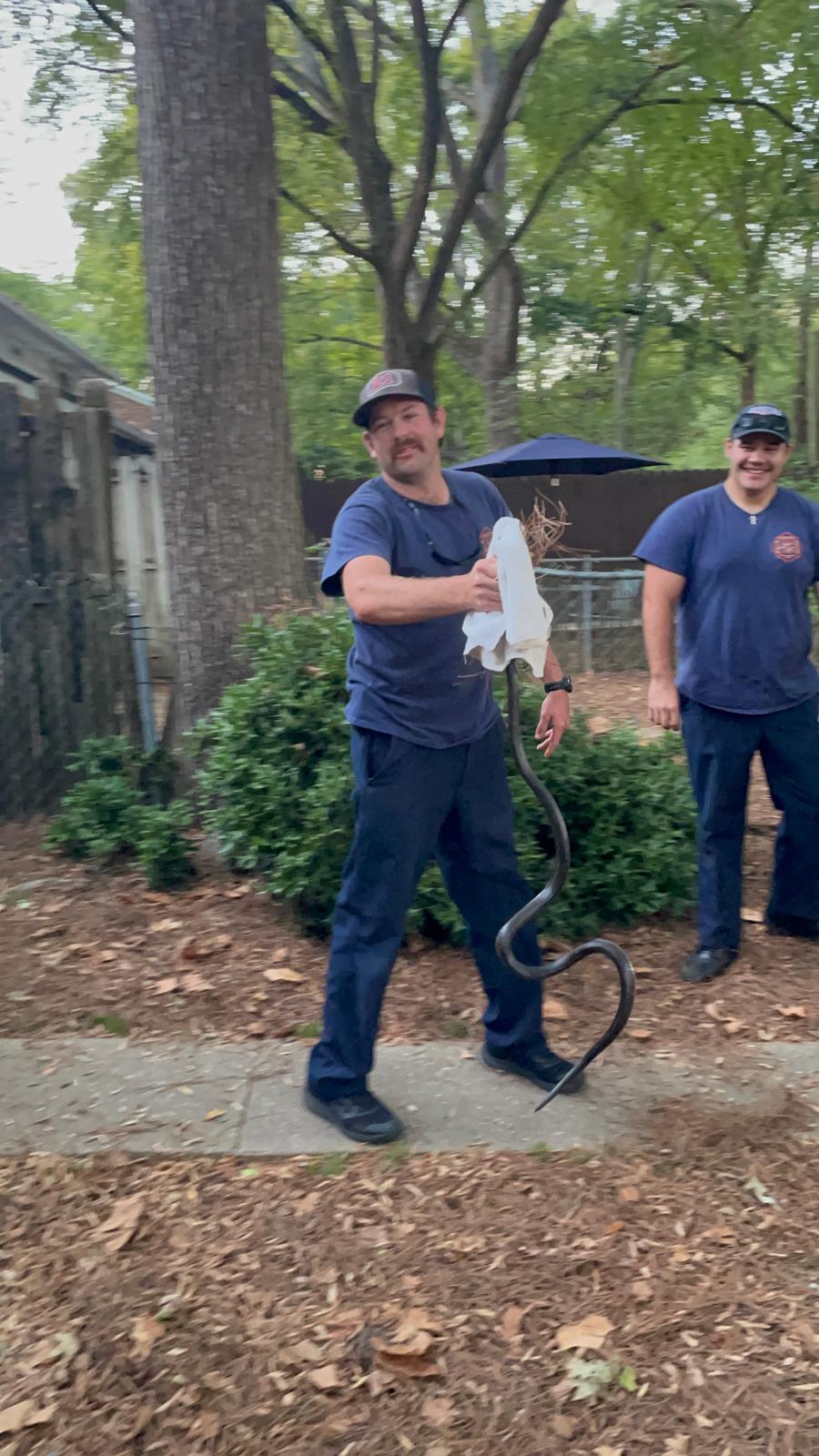
And then Vero and I remembered one important detail: there was a fire station right next to us. Firefighters deal with all kinds of situations. Why not a snake? So the two of us walked over to the station, explained the situation and… they came. Not one. Five firefighters. Five firefighters versus one snake. Except that the snake, perhaps satisfied with the impressive mobilization of forces it had managed to produce, had disappeared. The firefighters searched the yard and explained to us, just as Mark had, that it wasn’t venomous. Yes, it could bite, but it was a “good” snake. Our position remained unchanged: — If it’s that good, take it home. We don’t want it.


With the suspect nowhere to be found, the firefighters returned to the station. And we returned to the table. Theoretically. In practice, we sat almost motionless, each of us watching a different part of the yard. The Extension discussion continued, but at the same time we had already begun considering alternative accommodation options. A hotel seemed like a reasonable choice. Preferably a room on as high a floor as possible. And then the snake reappeared.
Vero ran to the fire station. This time, she found them having dinner. They left their meal and came back once again to rescue the Romanians. And this time, the snake was there. They caught it. With a towel.
After our entire mobilization – Animal Control, the landlord, discussions about calling 911, two visits from the firefighters, and plans to evacuate to a hotel – the problem was solved with a towel. The firefighters left with the snake, we took, of course, the official photo documenting the operation, and then we went back to the yard.


And we stayed there until late. Discussing Extension. Because, after all, that was why we had gathered in the first place. It was probably the most complete “Welcome to Georgia!” we have received so far. Since then, we have been paying a little more attention to where we step.
And the next day, a chipmunk was happily scampering around the yard. I looked at it and said: — Don’t worry. You’re safe now.
The opinions expressed on this blog are our own and do not reflect the official positions of the Fulbright Program, the University of Georgia, or USAMV Bucharest.



Lasă un răspuns